


Trump Administration Actions on Gun Violence So Far

The Trump Administration Takeaways
This page outlines the Trump administration’s attacks on gun violence prevention policies, funding, and public safety.
Under President Trump’s administration:
- Law enforcement has fewer tools to fight and solve gun crime
- Prohibited people can access firearms more easily
- Gun accessories to turn firearms into machine guns have been legalized
- Suppliers of crime guns are protected instead of being held accountable
- Critical safeguards to protect veterans are being removed
- Public health and safety infrastructure is dismantled
President Donald Trump took office on January 20, 2025. When he came into the White House, the U.S. was seeing violent crime drop to near-50-year lows. But almost immediately, Trump began dismantling decades of bipartisan progress to reduce crime and prevent gun violence.
Amid threats to human rights and the dismantling of democracy, keeping track of what is happening on the gun violence prevention front can be challenging. Make no mistake: the deluge of executive orders, federal layoffs, and discriminatory rhetoric is designed to be dizzying, distracting us from seeing the full picture of the chaos being inflicted under this administration’s watch.
That’s why we are monitoring the threats to public safety being pushed from the White House and the halls of Congress. These rollbacks advance an extreme “guns everywhere” agenda with life-threatening consequences for our communities.
Keep reading to see the broad impact of these actions, what else Trump has done to dismantle gun safety, and how you can join us in pushing back against these threats.
Trump Admin Actions Threaten Public Safety
Shut Down the White House Office of Gun Violence Prevention on Day 1 in Office
-
The White House Office of Gun Violence Prevention had been responsible for coordinating the federal government’s response to gun crime and gun violence, including mass shootings.
Issued an Executive Order to Gut Critical Gun Crime and Safety Policies
-
The “Protecting Second Amendment Rights” executive order explicitly targeted “All Presidential and agencies’ actions from January 2021 through January 2025,” clearly targeting the prior administration’s progress on the issue.
Repealed ATF’s “Zero Tolerance” Policy
-
This policy tasked the Bureau of Alcohol, Tobacco, Firearms and Explosives (ATF) with revoking the licenses of gun dealers who willfully violated important federal laws—helping hold law-breaking gun dealers accountable. Repealing this policy reduces oversight of and accountability for the bad-actor gun dealers who put our communities at risk.
Created a Task Force to Enact the Gun Lobby’s Agenda
-
The Second Amendment task force is aimed at advancing the gun lobby’s “guns everywhere” agenda to put more guns in more hands in more places.
Sought to Gut Funding for Life-Saving Programs
-
Trump attempted to gut grant funding for, among others, domestic violence prevention organizations and community-based violence intervention (CVI) programs. CVI programs have historically faced significant funding gaps that are now widened at the federal level—even though CVI programs have been shown to reduce gun violence, helping to make America safer. The administration also disqualified CVI organizations from directly applying to a grant program specifically designed to support their work.
Settled in a Case to Essentially Legalize Machine Guns
-
On May 16, 2025, the Trump administration reached a settlement in a case brought by the National Association for Gun Rights challenging an ATF ruling that banned forced-reset triggers, which enable semi-automatic firearms to fire like fully automatic, illegal machine guns. The settlement permits the sale of these devices.
The “One Big Beautiful Bill Act” Made America Less Safe for Everyone
-
On July 4, 2025, President Trump celebrated the country’s birthday by putting everyone at higher risk of gun violence. With the signing of the “big, beautiful bill,” President Trump and his allies in Congress made it cheaper and easier to buy some of the most dangerous and highly regulated weapons, including silencers, short-barreled rifles and shotguns, and other easily concealable firearms.
Decimated Key ATF Agent Capacity and Threatened Community Safety
-
Since taking office, the Trump administration has slashed millions in funding for federal law enforcement, reportedly reassigning 80% of ATF agents who normally investigate gun crimes—including firearm trafficking—to carry out its immigration “crackdown.” The administration is diverting critical resources away from stopping gun crime and violence where they are most needed, coinciding with a high number of gun violence incidents carried out by ICE agents. The Trump administration should be focused on protecting our communities—not threatening them with armed and masked ICE agents.
Removed Protections for At-Risk Veterans
-
On February 17, 2026, the Trump administration made it easier for veterans in mental health crises to get their hands on guns—in the middle of a veteran suicide epidemic. Veterans are three times more likely to die by gun suicide than non-veterans, and this action removes a critical safeguard that has been in place for three decades. When the federal government should be doing everything it can to protect at-risk veterans from the irreversible harm that can occur when someone in crisis has access to a firearm, the Trump administration is doing the exact opposite.
Happening now: The Trump administration is risking the lives of veterans
The Department of Veterans Affairs (VA) has described firearms as “the most lethal means of suicide.” When someone is in crisis, easy access to a gun can turn a temporary moment into a permanent tragedy.
And yet, in February 2026, the Department of Veterans Affairs announced changes in policy and potential changes in federal regulations that will weaken our background check system and endanger veterans. Veterans are three times more likely to die by gun suicide than non-veterans, and this action removes a critical safeguard that has been in place for three decades.
The VA’s misguided actions build on a provision that was enacted in March 2024 that temporarily blocks the VA from sharing critical information with the FBI on vulnerable veterans who are prohibited from purchasing guns because of mental health conditions unless a court has also determined that the person poses a danger to self or others. Now, the Trump administration is going even further by trying to purge thousands of existing veteran mental health records from the background check system without any review of dangerousness, and even ordering ATF to rewrite longstanding rules about who is and who isn’t allowed to have guns.
And if this wasn’t bad enough, extremists in Congress are working to make these changes permanent law by passing the Veterans 2nd Amendment Protection Act.
Let’s be clear: This isn’t a technical fix: It’s an attack on our background check system that will put many veterans at greater risk.
While Trump’s attacks on public safety are designed to make us feel powerless, we’re not backing down. Together we can speak out to protect our communities and save veterans’ lives.
Thanks to the Trump administration, critical public health and safety infrastructure has been, or is being, dismantled.
So far during his second term, Trump has shuttered the White House Office of Gun Violence Prevention, decimated CDC capacity, and advanced a “pro-gun agenda.” He has also jeopardized the mental health and physical safety of law enforcement, veterans, children, and communities through sweeping federal layoffs and funding cuts.
Learn more about this administration’s dangerous actions below.
-
Closed the White House Office of Gun Violence Prevention within 48 hours of taking office
The WHOGVP operated similarly to FEMA and was the first central hub for coordinating a federal response to gun violence. Shuttering this office silos the work of federal agencies as they respond to daily gun violence and mass shootings, potentially slowing how quickly support reaches the communities who need it most. Learn more about how the WHOGVP operated during the Biden administration.
-
Issued “Protecting Second Amendment Rights” executive order
Trump directed the Department of Justice (DOJ) to dismantle proven safety measures enacted by the Biden administration, including those that helped reduce gun crime. The Executive Order directed Attorney General Pam Bondi to “assess any ongoing infringements of the Second Amendment…and present a proposed plan…to protect the Second Amendment rights of all Americans.” But this action isn’t about the Second Amendment: It’s about a disregard for public safety.
These so-called “infringements” are the steps that the Biden administration took that helped contribute to the significant nationwide drop in violent crime. Let’s be clear: Those steps were consistent with the Second Amendment. The Supreme Court has held time and again that:
- The Second Amendment is “not unlimited,”
- “[L]aws imposing conditions and qualifications on the commercial sale of firearms” are constitutional, and
- The Second Amendment does not protect “dangerous and unusual weapons.”
Despite these well-established constitutional principles, gun extremists in and outside the Trump administration continue to claim that any action having anything to do with firearms is an “unconstitutional infringement” on the Second Amendment.
These claims are without merit and distort actual Second Amendment jurisprudence to push the gun lobby’s “guns everywhere” agenda: More guns in more hands in more places, no matter the cost to the public.
-
Created a “Second Amendment Task Force”
In the statement announcing the DOJ Task Force, U.S. Attorney General Pam Bondi emphasized that its work will serve “to advance President Trump’s pro-gun agenda.” Per the memo that established the Task Force, it is made up of representatives from across the government, including:
- Bondi and members of her staff
- The Associate Attorney General
- The Office of the Deputy Attorney General
- The Office of the Associate Attorney General
- The Office of the Solicitor General
- The Civil Rights Division
- The Bureau of Alcohol, Tobacco, Firearms and Explosives (ATF)
- The Federal Bureau of Investigation (FBI)
- “Any other components or representatives” that Bondi “may from time to time designate to assist in the Task Force’s labors.”
It is likely that this Task Force will shift critical Department personnel, resources, and efforts from gun violence prevention to industry-favored priorities.
-
Decimated CDC Capacity
In April 2025, “roughly 10,000 employees were cut” from the Department of Health and Human Services (HHS), including entire teams from the Centers for Disease Control and Prevention (CDC)’s Injury Center. The Injury Center collects data about violent deaths and injuries, including:
- Overdoses
- Suicides
- Traumatic brain injuries
- Domestic violence
- Multiple forms of youth violence
- Drowning
- Gun violence, including homicides and unintentional shootings
Critically, the CDC Injury Center is the only entity with the resources and personnel to aggregate this data, providing a comprehensive picture of violent injury that informs what other federal agencies, states, and private-sector organizations do on injury, violence, and prevention. Following the HHS layoffs, even staff remaining at the CDC face significant barriers to carrying out their life-saving work and data collection, as “the entire branch charged with analyzing data for the injury center and maintaining a key database were fired, leaving the systems largely unattended.”
-
Removed the Surgeon General’s Public Health Guidance on Gun Violence
In June 2024, then-Surgeon General Vivek Murthy declared gun violence in America to be a public health crisis—a historic first. That designation emphasized the importance of treating gun violence not just as isolated incidents, but as a national crisis that can be treated through prevention, intervention, and policy change. Removing the public health guidance glosses over the severity of our uniquely American problem, even as the administration advances actions to make it worse.
-
Attempted to Gut Life-Saving Resources and Funding
In April 2025, the DOJ sought to terminate grants funding critical public safety and violence intervention work. According to an analysis by the Council on Criminal Justice, these grants had a total initial award value of over $819 million and impacted “goals and issue areas” that touched “nearly every element of America’s safety and justice systems.” Although CVI programs have been shown to reduce violence, these programs saw the greatest cuts to their initial award value at nearly $169 million in terminated funding. This figure initially included $8.6 million in cuts for “evaluations, research, and related efforts.”
Other initial funding cuts included grants supporting:
- Funding for victims and survivors of violent crime;
- School safety initiatives, including the STOP School Violence Program designed to decrease violence in K–12 schools;
- Hate crime prevention and response; and
- Mental health and substance use interventions, including the Comprehensive Opioid, Stimulant, and Substance Use Program
In September 2025, the Department of Justice issued a FY25 application notice for the Community Based Violence Intervention and Prevention Initiative (CVIPI) grant. The CVIPI grant was created in 2022 to support community violence intervention (CVI) work. But the DOJ notice included drastic eligibility shifts from prior years, including disqualifying CVI organizations from applying to the funds designed to sustain their efforts.
A joint letter from CVI organizations across the country outlined various ways the DOJ changes jeopardize their life-saving work.
-
Risked the Physical and Mental Health of Veterans
An internal memo obtained by the Associated Press outlined plans to lay off over 80,000 workers at the VA, an agency whose workforce comprises over 25 percent veterans. As reported by ProPublica, approximately 9 million veterans receive health care from the Department of Veterans Affairs (VA).
Coupled with funding cuts to agencies and programs at the federal level, these reductions in resources for the VA are already causing “severe and immediate impacts” to the physical and emotional well-being of veterans. A January 2026 report indicated that the Trump administration’s actions resulted in “historic loss” of more than 40,000 VA employees in FY2025.
The report also highlighted “[s]piking VA mental health care wait times,” with many states “significantly exceeding the 20-day wait time threshold for veterans to be eligible for care in the community.” Comprehensive crisis support is critical for veterans. An average of 18 veterans die by suicide in the U.S. each day, 13 of them by firearm, and veterans are three times more likely to die by firearm suicide than their non-veteran counterparts.
In February 2026, the Department of Veterans Affairs announced changes in policy and potential changes in federal regulations that will weaken our background check system and further endanger veterans, removing a critical safeguard that has been in place for three decades.
The VA’s misguided actions build on a provision that was enacted in March 2024 that blocks the VA from sharing critical information with the FBI on vulnerable veterans who are prohibited from purchasing guns because of mental health conditions unless a court has also determined that the person poses a danger to self or others. Now, the Trump administration is going even further by trying to purge thousands of existing veteran mental health records from the background check system without any review of dangerousness, and even ordering ATF to rewrite longstanding rules about who is and who isn’t allowed to have guns.
-
The “One Big Beautiful Bill Act” Made America Less Safe for Everyone
On July 4, 2025, President Trump celebrated the country’s birthday by putting everyone at higher risk of gun violence. With the signing of the “One Big Beautiful Bill Act,” President Trump and his allies in Congress made it cheaper and easier to buy some of the most dangerous and highly regulated weapons, including silencers, short-barreled rifles and shotguns, and other easily concealable firearms.
This includes weakening provisions of the National Firearms Act (NFA) that have been in place for nearly 100 years. Under the NFA, anyone interested in buying or building a machine gun, silencer, short-barreled rifle or shotgun, or other easily concealed weapon must first submit an application to the Bureau of Alcohol, Tobacco, Firearms and Explosives (ATF) along with their fingerprints, a passport-style photo, and a $200 tax stamp before undergoing an enhanced background check. The “Big Beautiful Bill” eliminated the tax stamp requirement so that those seeking to make or purchase silencers, short-barreled rifles and shotguns, and other concealable weapons no longer have to pay this $200 tax.
The move is also yet another handout to the gun industry by the Trump administration in the midst of plummeting gun sales. The administration has also ushered in a “New Era of Reform” at ATF that limits oversight of the gun industry.
-
Undermined Long-Standing Basic Safeguards for Public Safety
In May 2025, the ATF decreased the number of life-saving background checks on gun sales. Under the Trump administration, the ATF now accepts more state permits as alternatives for NICS background checks. But in the past, officials had disqualified some of these permits after learning that some local law enforcement officials issued them without doing background checks. Even more concerning, some local officials had issued state permits after a background check denial.
One month later, the ATF ended a 25-year-old program that provided law enforcement with a critical tool used to identify and monitor the gun dealers who sell the most crime guns across the United States and trace used guns recovered at crime scenes.
And in January 2026, the Trump administration undermined a common-sense federal law that has been in place for 99 years. The administration declared that the law prohibiting handguns and other concealable firearms from being mailed through the Postal Service is unconstitutional and directed federal law enforcement and prosecutors not to enforce the law.
Under the Trump administration, law enforcement has fewer tools to fight and solve gun crime, while bad-actor gun dealers are emboldened and protected.
Since taking office, Trump has cozied up to the gun lobby, welcoming extremists like Kash Patel into key leadership positions. Trump has undermined the ATF’s ability to enforce gun laws that keep our law enforcement and communities safe, including by reportedly reassigning 80 percent of ATF’s special agents to carrying out his immigration “crackdown.” At the same time, Trump is making it easier for bad-actor gun dealers to circumvent the laws designed to promote public safety. And Trump has made significant cuts to programs designed to protect and support law enforcement serving communities across the country.
Learn more below about the impact of these actions.
-
Legalized Forced-Reset Triggers, Which Essentially Turn Semi-Automatic Rifles into Machine Guns
On May 16, 2025, the Trump administration reached a settlement in a case brought by the National Association for Gun Rights challenging an ATF ruling that banned forced-reset triggers, which automatically return forward (or reset) after being pulled. Forced-reset triggers increase a weapon’s rate of fire to mimic fully automatic guns—allowing a shooter to fire an entire magazine’s worth of ammunition in seconds.
Military-grade weapons of war don’t belong on our streets, which is why machine guns have been tightly regulated under federal law for 90 years. This deadly case settlement is yet another example of the Trump administration placing protecting “gun rights” over protecting the lives of our children and community members.
-
Filled Key Federal Agency Posts with Gun Extremists
When Trump took office in 2025, he began filling key federal leadership positions with gun extremists, including Dan Bongino and Kash Patel.
Patel, a dangerous extremist who started a foundation to help defend the extremists who attacked the U.S. Capitol on January 6, 2021, currently serves as the director of the FBI—an agency whose mission is to protect the public from violent crime, including gun violence. Patel has strong and extreme ties to Gun Owners of America, which opposes “all forms of background checks” and believes the ATF should be abolished. Patel previously served as the acting director of the ATF before being replaced by Secretary of the Army Dan Driscoll.
Meanwhile, Bongino—a former NRATV host, Fox News contributor, and frequent InfoWars guest—had a history of vilifying FBI agents for conducting investigations into President Trump. Bongino served for several months as the Deputy Director of the FBI.
-
Repealed the ATF “Zero Tolerance” Policy
The Trump administration announced the end of the Bureau of Alcohol, Tobacco, Firearms and Explosives (ATF) “zero tolerance” policy, a move specifically requested by the gun lobby. This policy tasked the ATF with revoking the licenses of gun dealers who willfully violate federal law, including by failing to run background checks, transferring firearms to prohibited persons, and/or falsifying records. While the “zero tolerance” policy was in place, the average number of monthly gun dealer inspections increased by 82 percent. As a consequence, gun stores that repeatedly failed to document gun sales and facilitated straw purchases were shut down. Now, the ATF has announced that Federal Firearm Licensees who had their licenses revoked under the “zero tolerance” policy “may reapply,” potentially allowing FFLs who willfully violated federal law to reopen their doors.
-
Reduced ATF Enforcement Capacity and Reassigned Agents to Trump’s Immigration “Crackdown”
ATF, the federal agency tasked with enforcing our nation’s gun laws, has, in its own words, faced “substantial external and internal challenges” in carrying out its key duties in recent years. In February 2024, the ATF’s Fiscal Year 2025 budget request included a request to add nearly 600 positions and “$208.1 million in program enhancements to support the Bureau’s mission objectives.”
One year later, however, the White House seems to think that, among other agencies, ATF’s duties are “found to be laden with spending contrary to the needs of ordinary working Americans.” Trump’s proposed FY 2026 budget includes a $468 million reduction in ATF budget and a plan to “refocus ATF enforcement and regulatory priorities.” That same budget also stated that ATF would eliminate nearly 550 Industry Operations Investigators, “reducing ATF’s capacity to regulate the firearms and explosives industries by approximately 40 percent in FY 2026.”
Additionally, the ATF has reportedly reassigned 80 percent of its special agents—usually tasked with overseeing the gun industry and investigating gun crimes—to carrying out President Trump’s immigration “crackdown.” These reassignments have led to a historic drop in gun trafficking investigations and dealer inspections.
The reassignments have also coincided with a dangerous pattern of gun violence and armed intimidation by federal agents that has wreaked havoc in communities across the country.
In January 2026, ICE agents shot and killed two American citizens—Renee Nicole Good and Alex Jeffrey Pretti—within weeks of each other in Minneapolis, Minnesota. Renee Good was unarmed. Pretti, an ICU nurse with no criminal record, was legally concealed carrying.
When anyone can be shot and killed in the street by federal agents, no one is safe from gun violence.
These horrific killings aren’t isolated incidents. They are part of a dangerous pattern of gun violence and armed intimidation by federal agents that has wreaked havoc in communities across the country. Reporting by The Trace shows a concerningly high volume of gun violence incidents carried out by US immigration agents since Trump began deploying ICE to various cities in June 2025. As of February 26, 2026, there have been at least 23 incidents of agents shooting at people—resulting in 6 people being killed and 12 people wounded—and another 43 incidents of agents holding people at gunpoint.
-
Defunded Programs Designed to Prevent Crime and Acts of Terrorism and to Support Law Enforcement
In April, the Department of Homeland Security slashed funding for “Centers of Excellence.” These Centers are Congressionally mandated through the Homeland Security Act and are housed in universities across the country to coordinate and “conduct groundbreaking research” into national security threats. One Center that is “scheduled for termination” and housed out of Northeastern University “develops strategies and innovative solutions to secure soft targets and crowded places from attacks,” including “schools, surface transportation, sports arenas, places of worship, large outdoor events, and retail facilities.” High-profile mass shootings have been perpetrated in all of these locations in the last decade.
Trump administration funding cuts have heavily impacted initiatives designed to reduce crime in rural locations and at the local and state levels and support law enforcement, including:
- Project Safe Neighborhoods (local crime)
- State and Local Anti-Terrorism Training (SLATT) program (domestic and international terrorism and hate crimes)
- Rural Violent Crime Reduction Initiative (financial support for rural law enforcement)
- Violent Crime Reduction Roadmap (centralized training and assistance for law enforcement and other officials)
- The VALOR Initiative, which strives to protect the physical and emotional health of law enforcement as they “navigate the challenging and often-dangerous conditions of their work.”
Learn more from the Council on Criminal Justice about the impact of these cuts.
-
Restored Gun Access to Dangerous Individuals
In March 2025, the Department of Justice bypassed a longstanding funding restriction imposed by Congress on a bipartisan basis that prevents ATF from restoring access to guns to prohibited persons by shifting that power back to DOJ. In doing so, the Trump administration, for the first time in more than 30 years, opened the door for individuals who are not allowed to have guns to regain access to them.
The move came just days after Elizabeth Oyer, then-U.S. Pardon Attorney for the Department of Justice, was abruptly terminated. Oyer alleges that her firing was connected to her refusal to restore the right of Mel Gibson, who was convicted on a misdemeanor domestic violence charge in 2011, to purchase or possess a firearm. Gibson’s gun ownership rights have since been restored.
Abusers with firearms are five times more likely to kill their female victims, and more than two-thirds of all intimate partner homicides in the United States are committed with a gun. Firearms in the hands of an abuser also pose a threat to the law enforcement responding to an incident. Department of Justice studies show that of officers killed responding to domestic disputes and domestic-related calls for service, 97 percent were killed with a firearm.
-
Delivered Gift to Gun Industry and Increased Likelihood of Guns Being Diverted to International Cartels
In September 2025, the Department of Commerce rescinded common-sense restrictions on the export of U.S.-made firearms to high-risk non-government purchasers abroad, with the stated intent to be “less burdensome” on the firearms industry.
These restrictions had gone into effect in 2024 after an extensive review to reduce the risk that firearms are diverted from legal to illegal commerce, and then used to commit crime and fuel violence and terror around the world. The rule gave the Department of Commerce new and improved tools to minimize these serious risks and strengthen U.S. national security.
Without proper oversight and controls, U.S.-made guns are used to commit human rights violations, stoke political violence, and foment regional instability. The Trump administration’s decision to rescind this rule and loosen these restrictions threatens to undermine our nation’s national security and foreign policy interests by making it easier for U.S. firearm exports to be diverted to or misused by bad actors abroad. Learn more about what the Department of Commerce’s rule did before the Trump administration’s reversal.
We’re Not Backing Down—and There’s a Way for Everyone to Join Us in Our Fight to End Gun Violence
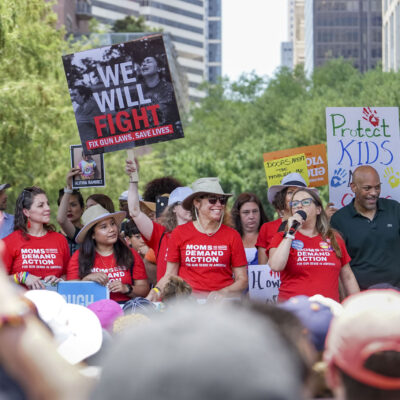
From funding cuts to undoing decades of bipartisan progress to removing a display of gun violence survivor stories from the ATF, Trump’s attacks on public safety are designed to make us feel powerless. We’re not backing down. And here at Everytown, more than 11 million parents, gun violence survivors, students, veterans, gun owners, teachers, health care workers, and everyday Americans have joined us in our fight for a future where everyone can be free of gun violence.
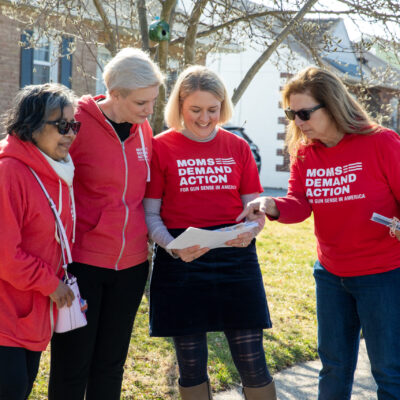
No matter who you are or how much spare time you have, you can take action or join the movement to end gun violence. From quick actions to volunteer opportunities to taking part in events near you, there’s a way for everyone to help end gun violence. And we’re counting on you to join us.